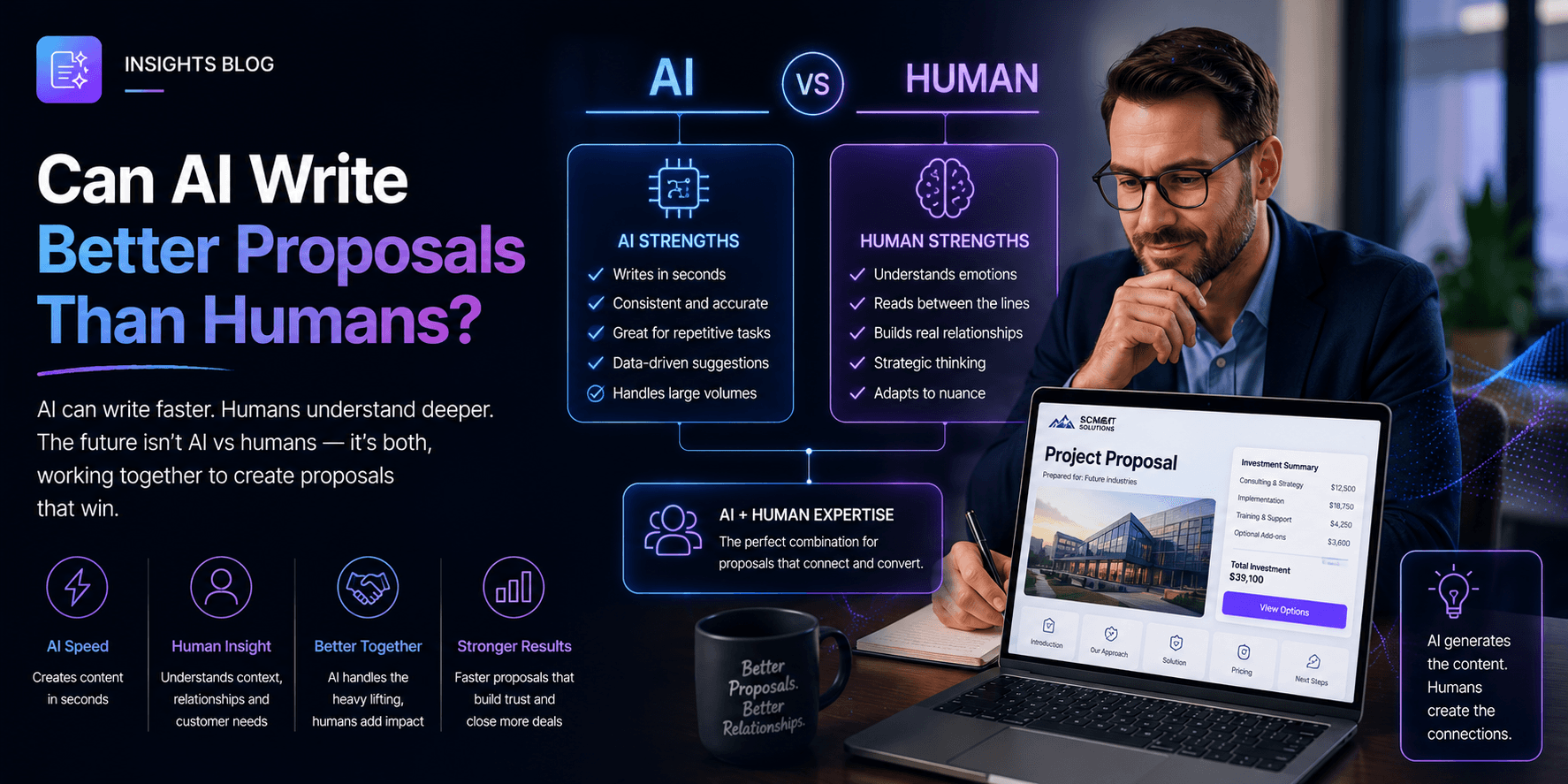
Can AI Write Better Proposals Than Humans?
AI is rapidly changing the way businesses create sales proposals, and naturally one question keeps appearing in sales meetings, boardrooms and marketing discussions everywhere:
Can AI actually write better proposals than humans?
It is an interesting question because proposal writing has always been seen as something deeply human. Strong proposals are not simply collections of information. They are part persuasion, part psychology and part relationship building. Great salespeople understand how to position ideas carefully, build confidence and shape conversations around what matters most to a customer.
At the same time, most businesses also know proposal writing can become painfully repetitive.
Entire sales teams spend huge amounts of time rewriting introductions, adjusting service descriptions, formatting pricing tables and rebuilding documents that are often only slightly different from the proposal they created yesterday.
That is exactly where AI starts becoming very powerful.
AI Is Already Better at Certain Parts of Proposal Writing
One thing businesses are discovering very quickly is that AI handles repetitive content generation extremely well.
Most proposal workflows involve reusing information that already exists somewhere inside the business. Product descriptions, case studies, onboarding explanations, project methodologies and pricing notes often get copied and rewritten repeatedly across hundreds of proposals every year.
Humans can obviously do this work, but it is time-consuming and inconsistent.
AI can now generate well-structured draft content in seconds using information businesses already have available. Instead of starting with a blank page every time, sales teams can begin with a proposal that is already partially assembled, professionally written and contextually relevant.
Businesses using AI-powered proposal workflows are increasingly finding that proposal creation no longer needs to be a slow administrative process sitting between customer interest and revenue generation.
In many cases, AI is already producing first drafts faster and more consistently than busy sales teams working manually.
But Great Proposals Are About More Than Words
This is where the conversation becomes far more nuanced.
Strong proposals are rarely successful simply because the writing itself sounds polished. Customers do not buy because a paragraph was beautifully structured or because the wording sounded corporate and impressive.
What customers are really responding to is confidence.
They want to feel understood. They want reassurance that the business understands their challenges, recognises their priorities and can successfully deliver the outcome being promised.
Experienced sales professionals naturally pick up on things AI still struggles to truly understand.
They notice hesitation during conversations. They sense internal politics inside customer organisations. They understand when proposals need to feel cautious, when they should feel ambitious and when customers need emotional reassurance rather than technical detail.
AI can imitate language patterns extremely well, but it does not genuinely experience customer relationships or commercial dynamics the way humans do.
The Risk of Over-Automation Is Very Real
One thing becoming increasingly obvious is that customers can already recognise generic AI-generated content surprisingly easily.
Overly polished wording, repetitive sentence structures and broad corporate language can make proposals feel strangely impersonal if businesses rely too heavily on automation without human refinement.
Ironically, proposals can sometimes become less persuasive when businesses try to automate too much of the human element out of the process.
Buyers still want to feel:
heard, understood and personally valued during important purchasing decisions.
The businesses getting the strongest results from AI are usually not the ones replacing salespeople entirely. They are the businesses using AI to remove repetitive workload while allowing experienced teams to spend more time on customer strategy and relationship building.
In many ways, AI works best when it becomes an assistant rather than the salesperson itself.
AI Is Changing What Sales Teams Spend Time Doing
Perhaps the biggest shift is not whether AI replaces proposal writers, but how it changes the daily work of sales teams altogether.
Traditionally, many salespeople spent enormous amounts of time trapped in document production. Formatting proposals, updating pricing spreadsheets, rewriting repetitive sections and manually adjusting layouts often consumed hours that could have been spent actually engaging with customers.
AI is beginning to remove much of that operational friction.
That creates a very different sales environment.
Instead of acting like part-time document administrators, sales teams can focus more energy on:
customer conversations, commercial positioning, relationship management and understanding business problems more deeply.
Interestingly, this may actually increase the value of experienced sales professionals rather than reduce it.
As AI handles repetitive content production, human expertise becomes more concentrated around trust, communication and commercial thinking.
Pricing Workflows Are Becoming Smarter Too
Proposal writing is only one part of the broader transformation happening inside sales workflows.
Pricing itself is becoming far more intelligent and interactive.
Many businesses now manage highly configurable products, recurring subscriptions, optional upgrades, tariffs, finance calculations and complex bundled services that are difficult to manage manually using spreadsheets alone.
Modern CPQ and proposal platforms are increasingly combining AI-assisted content generation with interactive pricing tables and dynamic proposal experiences.
Instead of proposals behaving like static documents, they are becoming much more responsive, collaborative and customer-friendly.
AI becomes part of a larger shift away from traditional PDF workflows altogether.
Different Industries Will Experience AI Differently
One of the interesting things about AI proposal generation is that its impact varies significantly depending on the industry.
Recruitment businesses may use AI to generate candidate summaries, onboarding scopes and staffing proposals more efficiently.
Manufacturing suppliers are beginning to use AI to organise highly configurable product catalogues and technical pricing structures.
Marketing agencies are using AI to help personalise campaign recommendations and proposal messaging, while accounting firms are exploring ways to streamline service agreements and advisory proposals.
Businesses across industries such as recruitment , marketing services , accounting and construction are all approaching AI differently depending on the complexity of their sales processes.
There is unlikely to be one universal AI workflow that fits every industry perfectly.
The Proposal Experience Itself Is Evolving
Another important shift happening alongside AI is the way proposals themselves are evolving.
Businesses are gradually moving away from thinking about proposals as downloadable documents and starting to view them more as interactive customer experiences.
Modern proposal platforms increasingly combine:
AI-generated content, visual presentation, interactive pricing, collaboration tools and customer engagement tracking inside connected digital workflows.
Platforms such as QuoteCloud are helping businesses create proposals that feel far more modern, dynamic and engaging than traditional static attachments.
In this environment, AI becomes less about replacing people and more about helping businesses deliver faster, smarter and more personalised customer experiences overall.
Final Thoughts
AI is already becoming better than humans at certain aspects of proposal writing, particularly when it comes to:
speed, consistency and repetitive content generation.
But truly great proposals still rely heavily on human judgement, emotional intelligence and commercial understanding.
Customers are not simply buying words on a page. They are buying confidence in the people and business behind the proposal itself.
At least for now, the strongest approach is not AI replacing humans.
It is AI helping experienced sales professionals work faster, communicate more clearly and spend more time focusing on the human side of selling that technology still cannot fully replicate.