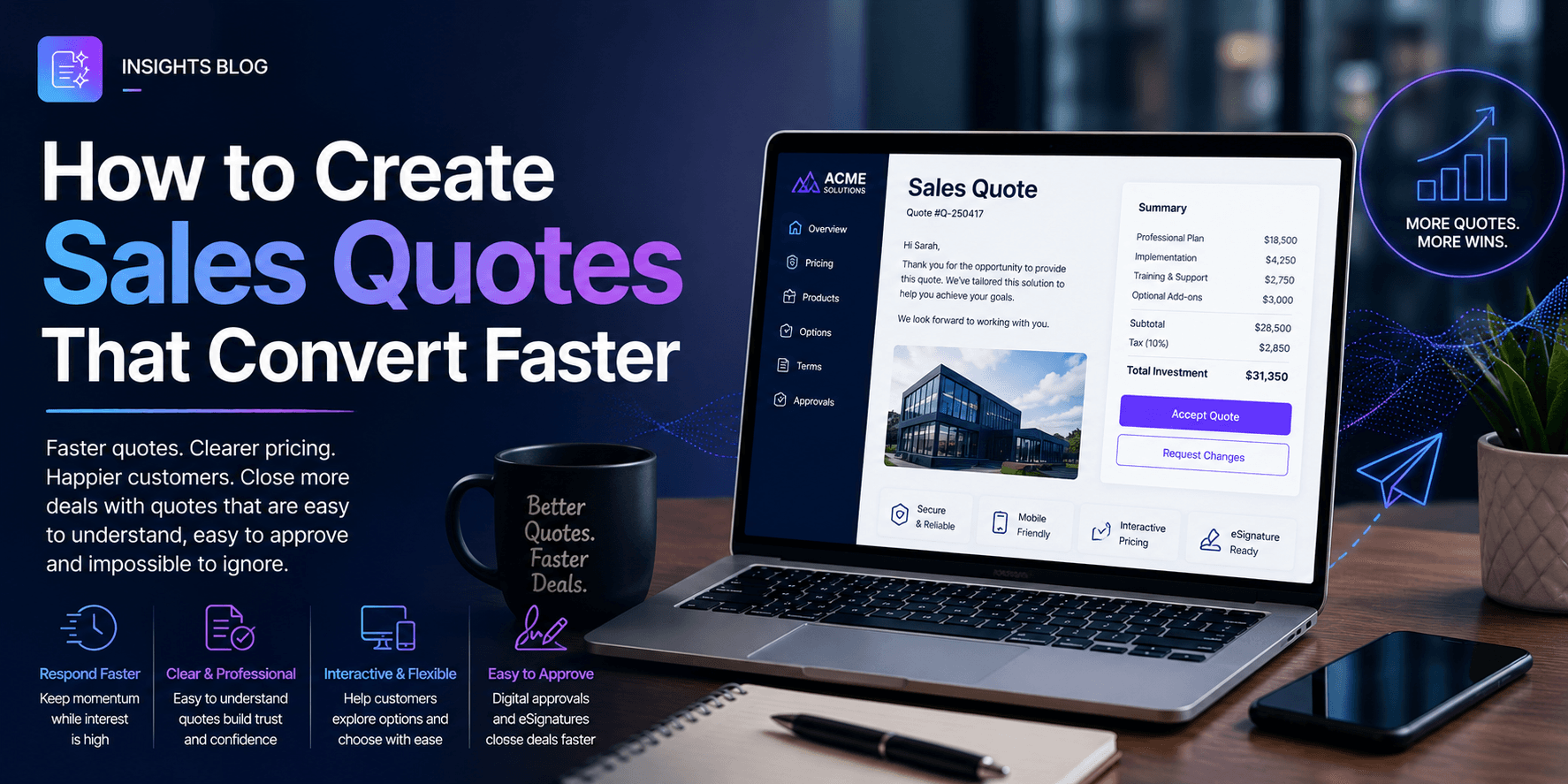
How to Create Sales Quotes That Convert Faster
Most businesses spend a lot of time trying to improve their sales results. They invest in marketing, generate leads, refine their sales process and train their teams to handle objections more effectively. Yet one of the most influential parts of the buying journey often receives surprisingly little attention.
The sales quote.
For many organisations, the quote is treated as an administrative task that happens after the selling is done. The customer asks for pricing, the sales team prepares a document and sends it across for approval. The assumption is that if the conversations went well and the pricing is competitive, the quote will take care of itself.
In reality, that is rarely how customers make decisions.
The quote is often the first moment where a customer sits down and evaluates your business without you in the room. Up until that point, the experience has been shaped by conversations, presentations and personal interactions. Once the quote arrives, the customer is left alone with the information you have provided and the impression you have created.
That moment matters far more than many businesses realise.
A surprising number of sales opportunities are not lost because the product was wrong or the price was too high. They are lost because momentum disappears. Customers become uncertain. Internal stakeholders struggle to understand the offer. Questions emerge that were not answered clearly enough. The buying process becomes harder than it needs to be.
When that happens, even highly interested prospects can drift away.
Faster Quotes Reduce Buying Friction
The fastest-converting sales quotes tend to have one thing in common. They reduce friction.
Not sales pressure. Not aggressive discounting. Not clever closing techniques.
They simply make it easier for customers to move forward.
This is where sales quoting software becomes valuable. When sales teams can produce accurate, professional and easy-to-understand quotes quickly, they keep customers engaged while the buying conversation is still active.
Speed matters because timing influences confidence. A quote that arrives quickly feels responsive and professional. A quote that arrives days later can make even a strong sales conversation feel less urgent.
The Quote Is Part of the Customer Experience
Think about the way people buy today. Whether someone is purchasing software, engaging a recruitment firm, selecting a marketing agency or investing in industrial equipment, they are constantly comparing experiences. Customers are increasingly accustomed to digital interactions that feel intuitive, responsive and easy to navigate.
Then many businesses suddenly switch back to a traditional quoting process.
A static PDF arrives. The pricing is buried halfway through the document. Optional services are difficult to compare. Internal stakeholders need to download attachments and piece together information themselves. Instead of helping the customer make a decision, the quote creates work.
The irony is that businesses often spend months refining their sales process only to introduce friction at the exact moment the customer is closest to saying yes.
This is why modern proposal software and quoting workflows are becoming so important. The quote is no longer just a pricing document. It is part of the buying experience.
Clarity Converts Faster Than Complexity
The strongest sales quotes no longer behave like pricing documents. They behave like buying experiences.
When customers can immediately understand what they are purchasing, why it matters and how to proceed, decision-making becomes easier. Confidence grows. Internal approvals happen faster. Discussions become more focused because everyone is looking at the same information in a structured way.
That shift is particularly noticeable in industries where products and services have become more complex.
A manufacturing company may need to present configurable equipment, installation services and ongoing maintenance agreements. A recruitment agency may need to explain multiple engagement models and placement options. An events business may need to package venues, catering, production and accommodation into a single commercial proposal.
The more complex the offering becomes, the more important simplicity becomes.
Businesses using CPQ software can create more structured pricing experiences that help customers compare options clearly instead of trying to interpret complicated spreadsheets or static quote documents.
Customers Are Really Looking for Confidence
Interestingly, customers rarely ask for simplicity directly.
They ask for confidence.
Confidence that they understand the investment. Confidence that they are comparing the right options. Confidence that the business can deliver what has been promised.
A well-structured quote creates that confidence naturally.
This is one of the reasons modern quoting platforms are changing the way businesses approach sales documentation. Instead of treating the quote as a static record of pricing, businesses are increasingly viewing it as an extension of the sales conversation itself.
Pricing becomes easier to explore. Optional items become easier to understand. Approvals become easier to complete. The customer spends less time trying to interpret information and more time evaluating the value being offered.
Approvals Should Feel Effortless
Even a strong quote can slow down if the approval process feels awkward.
Customers may be ready to move forward, but if they need to print documents, sign manually, scan files or coordinate approval through long email chains, hesitation can creep back into the process.
Modern quoting workflows increasingly combine interactive quotes with electronic signature and digital approval tools so customers can move from review to acceptance without unnecessary friction.
That distinction may sound subtle, but commercially it can be significant.
Customers do not buy because they fully understand every detail. They buy when they feel comfortable moving forward.
Final Thoughts
Ultimately, creating sales quotes that convert faster is not really about creating better pricing documents.
It is about creating a better buying experience.
Businesses that understand this are often the ones that close opportunities more quickly, create stronger customer impressions and spend less time chasing approvals after the quote has already been delivered.
The quote may feel like the final stage of the sales process.
Increasingly, it is becoming one of the most important.
QuoteCloud helps businesses create faster, clearer and more engaging quote experiences through interactive sales quoting and proposal workflows designed for modern customer buying journeys.