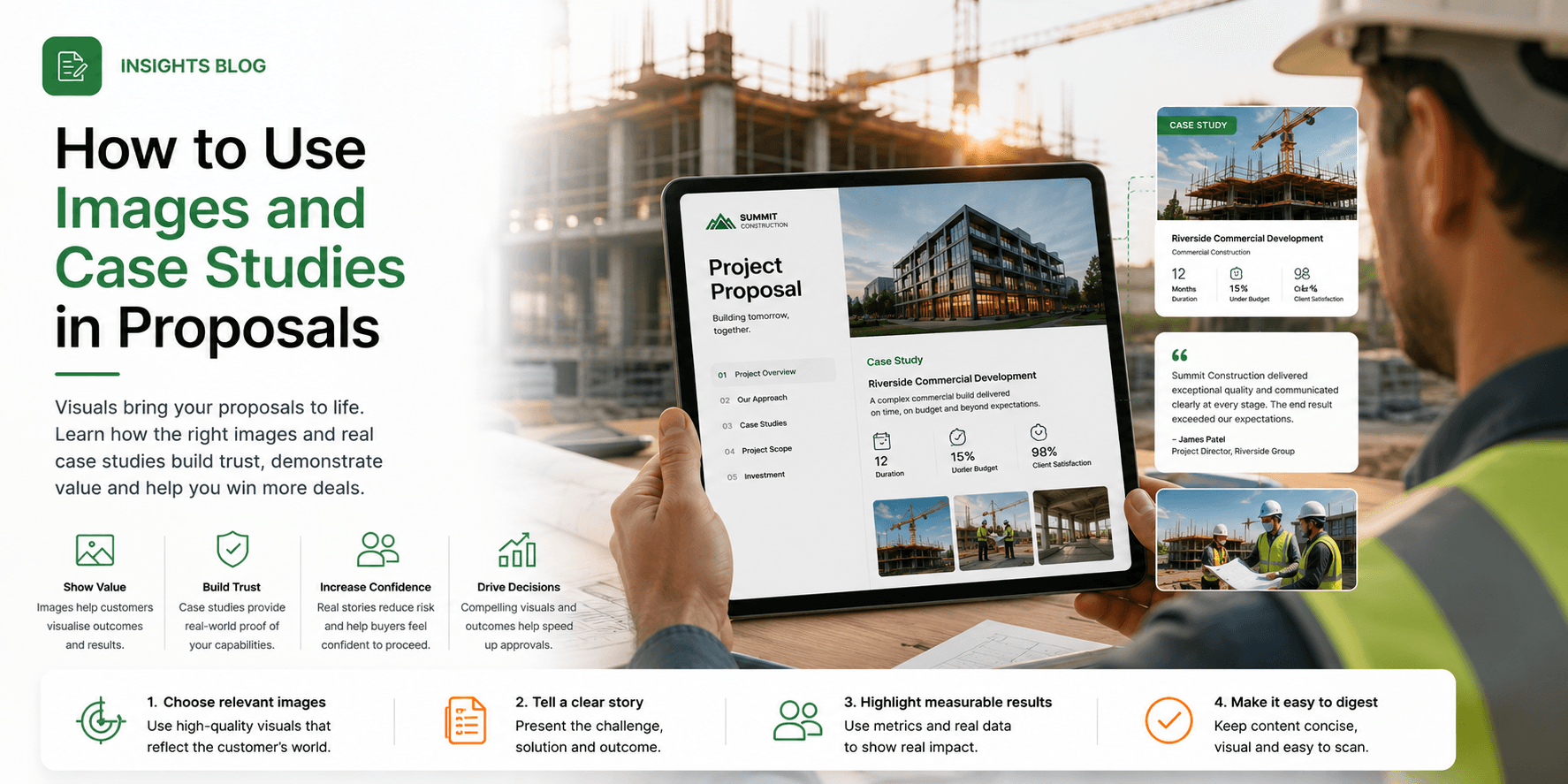
How to Use Images and Case Studies in Proposals
Most proposals fail to engage customers because they rely too heavily on text while doing very little to help buyers emotionally visualise the outcome being sold.
Customers rarely purchase products or services based purely on technical specifications alone. They buy confidence, credibility, outcomes and reassurance that your business understands their problem and can successfully deliver the solution.
Images and case studies are two of the most powerful tools available inside modern sales proposals because they help customers:
visualise success, understand value faster and emotionally connect with the solution being presented.
When used properly, they can significantly improve engagement and conversion rates throughout the sales process.
Why Visual Content Matters in Proposals
Modern buyers consume information visually far more than they did even a decade ago.
Customers are now conditioned by:
websites, social media, streaming platforms, ecommerce experiences and modern apps that prioritise visual communication over long-form text.
Traditional proposals that rely entirely on dense paragraphs and pricing tables often feel outdated and difficult to engage with.
Strong visual proposals create a much more natural reading experience by helping customers process information quickly and confidently.
Businesses using visual proposal software are increasingly using imagery, layouts and interactive content to create proposal experiences that feel more modern and commercially engaging.
Images Help Customers Visualise Outcomes
One of the biggest mistakes businesses make in proposals is focusing too heavily on explaining features instead of helping customers imagine the final result.
Strong imagery changes this completely.
In industries such as:
construction, travel, architecture, events, manufacturing and real estate, visual content helps customers immediately understand the quality and scope of the proposed solution.
A customer reviewing a travel proposal becomes far more emotionally engaged when they can see:
destinations, accommodation imagery, maps and itinerary visuals rather than reading plain text descriptions alone.
Similarly, construction proposals become far more compelling when they include:
renders, completed projects, site photography and implementation visuals.
The goal is not decoration. The goal is emotional clarity.
Case Studies Build Trust Faster Than Claims
Most businesses claim they deliver excellent results. Customers expect those claims.
What buyers really want is proof.
Case studies provide real-world evidence that your business has successfully solved similar challenges before.
They help reduce perceived risk by showing:
practical outcomes, implementation examples, measurable improvements and customer success stories.
Strong case studies often become one of the most persuasive sections within a proposal because they move the conversation away from theory and into demonstrated capability.
The Best Case Studies Focus on Outcomes
Many businesses write case studies that focus too heavily on themselves rather than the customer outcome.
The strongest case studies are usually structured around:
the customer problem, the implemented solution and the measurable business result.
Customers want to quickly understand:
what challenge existed, how it was solved and what improvement was achieved.
Simple, concise storytelling often works better than long technical explanations.
Businesses using modern document generation workflows can also dynamically insert relevant case studies into proposals based on industry, customer type or product category.
Use Industry-Relevant Visuals
Generic stock photography rarely creates strong engagement inside proposals.
Customers respond far more positively to visuals that feel authentic and closely aligned with their industry or operational environment.
A proposal for:
manufacturing should visually feel different from a proposal designed for travel, telecommunications or recruitment services.
Industry-relevant visuals help customers feel that the proposal was created specifically for their business rather than reused from a generic template.
Businesses operating across industries such as construction , travel and IT services are increasingly using tailored visual content to create more personalised customer experiences.
Visual Hierarchy Improves Readability
Images should not overwhelm the proposal or distract from the commercial message.
Good proposal design uses visual hierarchy carefully to guide customer attention naturally through the document.
Images and case studies should support:
key decision points, pricing explanations, implementation discussions and trust-building moments throughout the proposal.
Strong layouts create breathing space between sections and reduce the cognitive fatigue often associated with long-form proposal documents.
Businesses investing in modern proposal workflows are increasingly recognising that proposal usability directly affects conversion performance.
Images Can Support Complex Explanations
Complex solutions are often much easier to explain visually than through text alone.
Diagrams, workflow illustrations, implementation timelines and process maps can significantly improve customer understanding.
This is particularly valuable for industries such as:
telecommunications, software implementation, manufacturing and technical consulting where multiple moving parts may need to be communicated clearly.
Visual explanations reduce customer confusion while making proposals feel more approachable and easier to review internally.
Case Studies Also Help Internal Stakeholders
In many B2B sales environments, the person reviewing the proposal is not the final decision-maker.
Proposals often move through:
finance teams, procurement departments, executives and operational stakeholders before approval occurs.
Well-structured case studies help internal champions justify the decision more easily because they provide evidence that similar businesses have already achieved successful outcomes.
This frequently accelerates approval processes and reduces sales friction.
Interactive Proposals Make Visual Content Even More Powerful
Modern proposal experiences are increasingly moving beyond static PDFs entirely.
Interactive proposals allow businesses to embed:
galleries, expandable content, videos, pricing interactions, maps and customer journeys directly inside the proposal experience.
This creates far more engaging customer interactions than traditional document attachments.
Businesses using collaborative proposal workflows can also improve internal and customer communication throughout the proposal review process itself.
Balance Professionalism With Emotion
Strong proposal visuals should feel professional while still creating emotional connection.
The objective is not to turn proposals into marketing brochures filled with decorative imagery.
Instead, visuals should:
clarify information, reinforce trust, support storytelling and help customers feel more confident about the buying decision.
The best proposals create a balance between:
commercial professionalism, usability and emotional engagement.
Final Thoughts
Images and case studies play a critical role in helping modern proposals feel more persuasive, engaging and commercially credible.
Strong visuals help customers understand outcomes faster, while case studies provide proof that your business can successfully deliver similar results.
Businesses that combine:
visual storytelling, real-world proof and modern proposal workflows often create proposal experiences that feel significantly more compelling than traditional text-heavy documents.
In increasingly competitive markets, that improved customer experience can become a major competitive advantage.