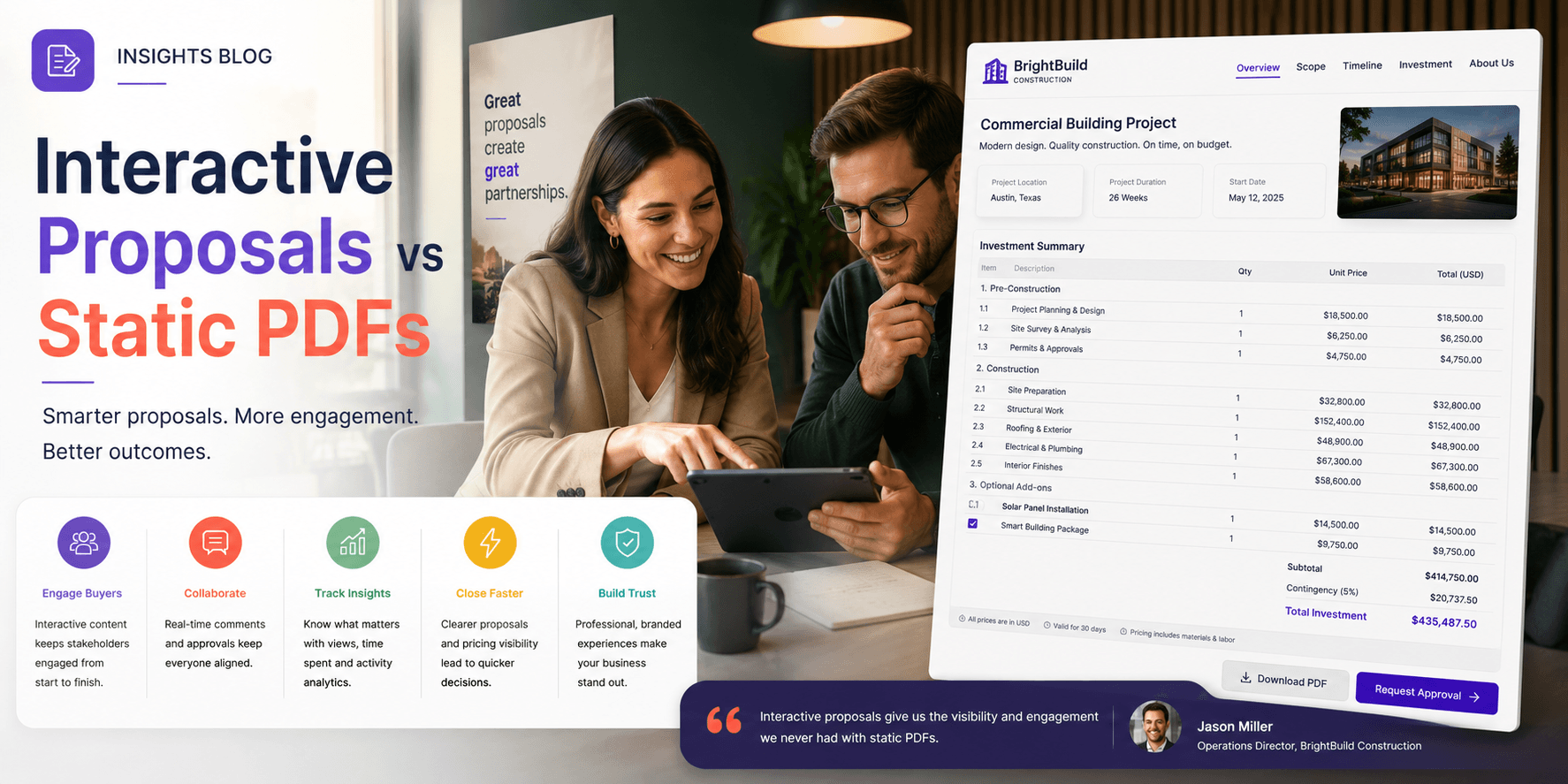
Interactive Proposals vs Static PDFs
Most businesses still send proposals the same way they did 15 years ago. A document gets created, exported as a PDF, attached to an email and sent off into the unknown with the hope the customer reads it carefully enough to understand the value being offered.
The problem is that customer behaviour has changed dramatically, while proposal workflows often have not.
Modern buyers are now used to digital experiences that feel interactive, visual and easy to navigate. Whether it is online shopping, banking apps, streaming platforms or collaborative business software, almost every digital interaction today is designed around usability and engagement.
Then suddenly, during the most important stage of the sales process, customers are sent a static PDF attachment that feels disconnected from the rest of the modern buying experience.
That gap is one of the biggest reasons interactive proposals are quickly replacing traditional static documents across many industries.
Static PDFs Create Distance
PDFs are still useful for certain things. They work well for archived records, contracts and printable documents. But they were never really designed to create engaging customer experiences.
The moment a proposal becomes large, detailed or commercially complex, static PDFs often start creating friction.
Customers end up scrolling through dozens of pages trying to compare options, understand pricing or find key information buried deep inside the document. On mobile devices the experience becomes even worse, with endless zooming and awkward navigation.
In many cases, customers are reviewing proposals quickly between meetings, while travelling or during internal discussions with stakeholders. If the proposal feels difficult to consume, engagement drops very quickly.
Interactive proposals approach this very differently.
Instead of presenting information like a printed document, they behave more like a guided digital experience. Customers can move naturally through sections, explore pricing, review visuals and interact with information in a way that feels far more aligned with how people consume content online today.
The Buying Experience Feels More Modern
One of the biggest advantages of interactive proposals is that they feel alive.
Customers are no longer staring at a flat attachment. Instead, they are engaging with a branded experience that can include visual content, pricing interactions, case studies, videos, expandable sections and dynamic layouts.
Businesses using interactive proposal software are increasingly treating proposals as part of the customer journey itself rather than simply the final document sent before a sale closes.
That shift is important because buyers often judge professionalism not only by what is being sold, but by how the business presents itself during the sales process.
A modern proposal experience immediately creates the impression that the business is organised, digitally capable and easy to work with.
Pricing Becomes Easier to Understand
Pricing is where many traditional proposals become difficult to navigate.
Large static pricing tables often force customers to manually compare packages, interpret inclusions or work out how optional items affect the overall investment.
Interactive proposal platforms change this completely by allowing pricing to become part of the customer experience itself.
Customers can explore options more naturally, review upgrades, compare packages and understand totals without needing to jump backwards and forwards through multiple pages.
Businesses using CPQ and interactive pricing workflows are increasingly helping customers participate in the buying process instead of simply reading static numbers from a document.
That level of interaction builds confidence because the proposal feels clearer and more transparent.
Collaboration Happens More Naturally
Most business purchases involve more than one decision-maker.
Proposals are often passed between finance teams, executives, procurement staff and operational managers before approvals happen. Static PDFs tend to create fragmented communication because discussions become spread across forwarded emails, downloaded attachments and multiple document versions.
Interactive proposals create a much more connected experience.
Businesses using collaborative proposal workflows can centralise engagement, revisions, approvals and customer interaction inside a single environment instead of relying entirely on disconnected email conversations.
This often shortens the sales cycle because customers spend less time trying to coordinate information internally.
Interactive Proposals Work Better on Mobile Devices
A huge number of proposals are now first opened on phones or tablets.
That alone changes how proposals should be designed.
Static PDFs often feel frustrating on smaller screens because they were originally built around fixed page layouts designed for printing.
Interactive proposals built using modern responsive frameworks adapt far more naturally across devices. The experience feels cleaner, easier to navigate and more intuitive regardless of screen size.
Customers can quickly access pricing, visuals, timelines and proposal sections without constantly zooming or scrolling through oversized document pages.
The Proposal Feels More Like a Sales Experience
One of the most interesting things about interactive proposals is how they shift the psychology of the sales process.
Static PDFs feel transactional. Interactive proposals feel consultative.
The customer experience becomes more engaging because the proposal feels like an extension of the sales conversation rather than the end of it.
This is especially valuable in industries where proposals are visually important or commercially complex.
Businesses operating in travel , construction , telecommunications and IT services often need to communicate multiple products, pricing structures, visuals, timelines and service inclusions clearly.
Interactive proposals make this process significantly easier for both the business and the customer.
Customers Now Expect Better Digital Experiences
This is really the core issue.
Customer expectations have evolved.
Businesses spend heavily on modern websites, polished branding and digital customer experiences, yet many still rely on proposal workflows that feel stuck in an earlier generation of software.
The proposal is often one of the final and most important interactions before a customer makes a purchasing decision.
If that experience feels outdated, difficult or disconnected, it can subtly weaken confidence in the business itself.
Interactive proposals help close that gap by creating experiences that feel more aligned with how modern businesses actually operate today.
Final Thoughts
Static PDFs are unlikely to disappear completely. They still have an important role for downloadable documentation, archived records and formal contracts.
But as customer expectations continue evolving, businesses are increasingly recognising that proposals are no longer just documents.
They are part of the overall buying experience.
Interactive proposals create stronger engagement, clearer pricing experiences, better collaboration and more modern customer journeys.
In competitive industries, that improved customer experience can become a genuine advantage when it comes to winning business faster and building stronger client relationships.