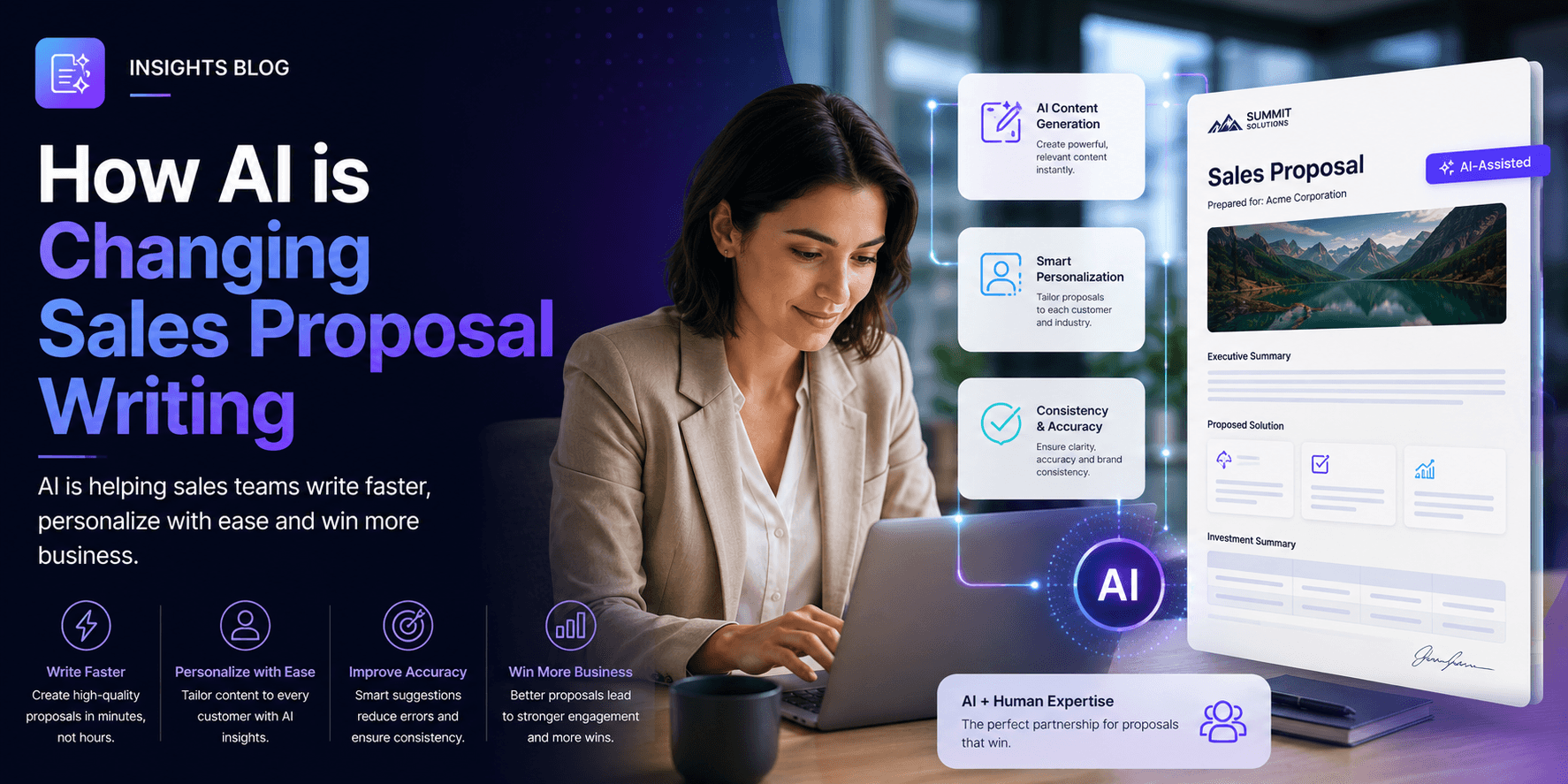
How AI is Changing Sales Proposal Writing
Sales proposals have traditionally been one of the most time-consuming parts of the sales process. Even experienced sales teams often spend hours pulling together content, adjusting pricing, rewriting introductions, formatting layouts and tailoring proposals for individual customers.
In many businesses, proposal writing became a bottleneck sitting between customer interest and revenue generation.
AI is starting to change that dramatically.
Over the past few years, artificial intelligence has rapidly moved from being a novelty feature into something that is beginning to reshape how businesses create proposals, sales quotes and customer-facing documents altogether.
But what is interesting is that AI is not simply making proposal writing faster. In many cases, it is fundamentally changing how businesses think about the entire proposal experience.
Proposal Writing Has Always Been Repetitive
Most sales teams spend a surprising amount of time rewriting information that already exists somewhere else in the business.
Product descriptions get copied between documents. Service explanations are adjusted slightly for different customers. Case studies are manually inserted. Pricing notes are rewritten repeatedly. Even proposal introductions often follow very similar patterns from one opportunity to the next.
The reality is that a large percentage of proposal writing has always involved repetition.
AI is particularly effective at helping businesses reduce this repetitive workload because it can quickly generate, restructure and personalise content using information already available within the sales process.
Instead of starting with a blank page every time, sales teams can now begin with intelligent draft content that is already contextually aligned with the customer opportunity.
Speed Matters More Than Many Businesses Realise
One of the biggest advantages AI brings to proposal workflows is speed.
In competitive industries, delays during proposal preparation can quietly damage sales momentum. The longer customers wait for a proposal, the more likely attention shifts elsewhere or internal urgency starts fading.
Businesses using AI-powered proposal workflows are increasingly reducing the amount of manual effort required to create personalised sales documents.
That speed allows sales teams to respond faster while opportunities are still active and customer engagement is high.
In many cases, simply delivering proposals quicker creates a surprisingly strong competitive advantage.
AI Helps Personalise Proposals at Scale
Customers expect proposals to feel personalised.
Generic sales documents are easy to recognise, especially when businesses are clearly reusing the same content across every opportunity.
The challenge for sales teams has always been balancing personalisation with efficiency.
AI helps bridge that gap by allowing businesses to tailor messaging, introductions, recommendations and proposal structure far more efficiently than traditional manual workflows.
Instead of producing identical proposals for every customer, businesses can now generate content that feels more relevant to:
the customer’s industry, business size, objectives or service requirements.
That personalisation creates stronger engagement because customers feel the proposal was genuinely prepared for their specific situation rather than recycled from a generic template.
AI Is Also Changing How Sales Teams Work Internally
The impact of AI goes beyond proposal writing itself.
In many businesses, proposal creation traditionally relied heavily on:
senior salespeople, subject matter experts or proposal specialists who held large amounts of knowledge in their heads.
That created operational bottlenecks because proposal quality often depended on a relatively small number of experienced individuals.
AI is beginning to distribute that knowledge more broadly across organisations.
Junior sales staff can now generate stronger draft content faster, while experienced sales teams can focus more of their energy on customer strategy, relationships and commercial positioning instead of repetitive document production.
This shift is helping businesses scale proposal quality more consistently across teams.
Pricing and Configuration Are Becoming Smarter
One of the most interesting areas of AI development is happening around pricing and product configuration.
Many proposals involve:
bundled services, optional upgrades, recurring pricing, finance calculations, tax considerations or highly configurable product combinations.
Traditionally, these workflows often relied on spreadsheets, manual calculations or disconnected pricing tools.
Modern CPQ and proposal automation platforms are increasingly combining AI assistance with interactive pricing workflows to help businesses create proposals more accurately and efficiently.
This becomes especially valuable in industries where proposals contain large product catalogues or highly configurable pricing structures.
AI Still Needs Human Oversight
Despite all the excitement around AI, one thing remains very important:
great sales proposals still require human judgement.
AI can generate content quickly, but it does not truly understand customer relationships, commercial nuance or emotional buying dynamics in the same way experienced sales professionals do.
The strongest proposal workflows are usually the ones where AI supports the sales team rather than replacing it entirely.
Businesses that use AI effectively tend to treat it as:
a collaborative assistant that accelerates workflows, improves consistency and reduces repetitive work while humans remain focused on strategy, positioning and customer trust.
The Proposal Experience Itself Is Evolving
AI is also influencing how proposals are presented, not just how they are written.
Businesses are increasingly moving away from static PDF workflows toward:
interactive proposal experiences that combine pricing, visuals, collaboration and personalised content inside modern digital environments.
Platforms such as QuoteCloud are helping businesses create proposal experiences that feel more dynamic and customer-friendly while AI assists with content generation and workflow automation behind the scenes.
This creates proposals that are not only faster to produce, but also more engaging for customers to review.
Different Industries Are Adopting AI in Different Ways
AI adoption inside proposal workflows looks different depending on the industry.
In travel, AI can help personalise itineraries and destination content based on customer interests.
In telecommunications and IT services, AI can assist with generating technical explanations and bundled service recommendations.
In construction and manufacturing, AI is helping businesses organise complex pricing structures, scopes of work and configurable product information more efficiently.
Businesses operating across industries such as travel , telecommunications , construction and IT services are increasingly integrating AI into their proposal workflows in ways that reflect their own sales complexity.
The Real Opportunity Is Better Customer Experiences
The biggest long-term impact of AI may not actually be speed alone.
The real opportunity is creating better customer experiences.
AI allows businesses to spend less time wrestling with document production and more time focusing on:
customer engagement, proposal quality, strategic positioning and sales relationships.
Customers increasingly expect proposals to feel:
personalised, visually engaging, relevant and easy to navigate.
AI is helping businesses deliver those experiences more consistently at scale.
Final Thoughts
AI is changing sales proposal writing because it is reducing many of the repetitive tasks that traditionally slowed proposal workflows down.
Faster content generation, improved personalisation, smarter pricing workflows and better consistency are all helping businesses create proposals more efficiently than ever before.
But perhaps more importantly, AI is helping businesses rethink proposals as part of a broader digital customer experience rather than simply another document to send by email.
The businesses that embrace this shift thoughtfully are likely to create proposal experiences that feel faster, more engaging and significantly more competitive in the years ahead.