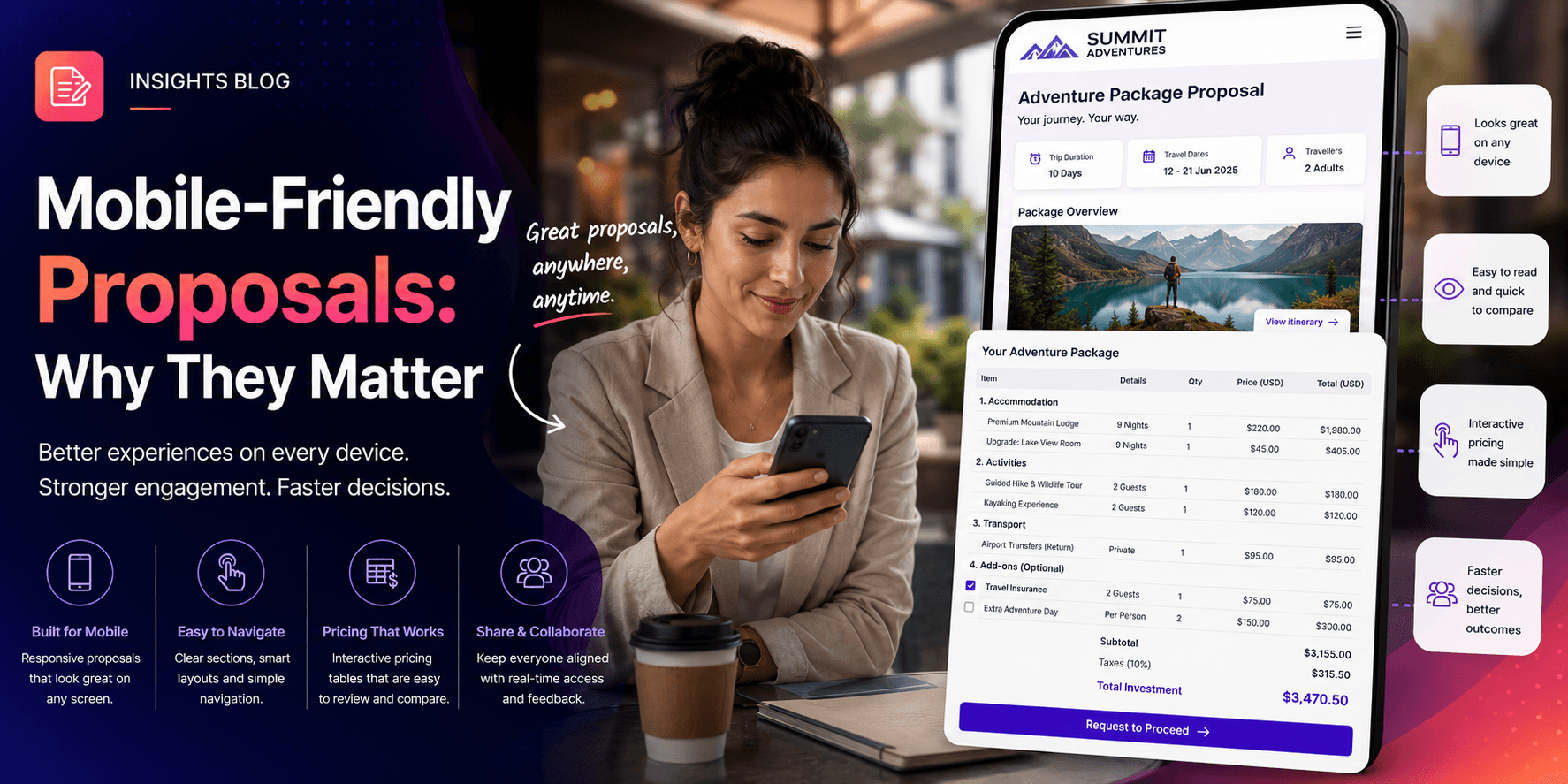
Mobile-Friendly Proposals: Why They Matter
There was a time when sales proposals were almost always reviewed in an office, usually sitting at a desk in front of a desktop computer. Sales teams designed documents for large screens, printed copies for meetings and assumed customers would carefully work through every page from beginning to end.
That is no longer how people buy.
Today, proposals are opened everywhere. A customer might first review your pricing while sitting in an airport lounge. A manager could quickly scan your proposal between meetings on their phone. A director may open it late at night from a tablet at home while discussing options with colleagues. In industries like construction, trade services or travel, proposals are often reviewed onsite or while people are actively moving between locations.
Yet many businesses still create proposal experiences that feel designed for another era.
Large PDFs, tiny text, complicated pricing tables and endless scrolling create friction at the exact moment customers are trying to make important buying decisions.
The Buying Experience Has Shifted to Mobile
Mobile devices are no longer secondary screens. For many people, they are now the primary way information gets consumed throughout the day.
Customers manage banking, approve invoices, collaborate with teams and purchase products directly from their phones. Naturally, those same expectations now apply to sales proposals as well.
The problem is that traditional proposal workflows have not evolved fast enough to keep up with that shift.
Many proposal documents still behave like printed brochures awkwardly squeezed onto smaller screens. Customers pinch, zoom and scroll their way through complicated layouts while trying to interpret pricing or compare options. Even a strong proposal can quickly become frustrating when the experience feels difficult to navigate.
Businesses using modern proposal software are increasingly recognising that usability is now part of the sales process itself.
Customers Rarely Read Proposals in One Sitting
One of the biggest misconceptions businesses have is assuming customers carefully read proposals from beginning to end in a structured way.
In reality, most buyers jump in and out of proposals throughout the day. They revisit pricing later, forward sections internally, compare options during conversations and return to specific details multiple times before a decision is made.
Mobile-friendly proposals support this behaviour naturally because they are easier to navigate quickly.
Instead of feeling trapped inside a rigid document, customers can move through proposal sections much more fluidly. Pricing becomes easier to review, optional services are clearer to compare and important information becomes easier to locate without frustration.
These small improvements may seem subtle, but collectively they create a much smoother customer experience.
Pricing Is Usually Where Mobile Experiences Fail
Pricing tables are often the first thing that breaks on mobile devices.
Traditional quote layouts were built for spreadsheets and desktop monitors, not smaller touch screens. Long descriptions, multiple columns and complicated calculations become extremely difficult to consume on a phone.
That matters because pricing is usually the section customers spend the most time reviewing.
Modern CPQ and interactive pricing workflows are changing this by making pricing feel more responsive and easier to interact with across devices.
Instead of forcing customers through static spreadsheets disguised as PDFs, interactive pricing experiences allow buyers to compare options, explore upgrades and review totals in a way that feels much more natural.
The easier pricing feels to understand, the more confident customers usually feel about moving forward.
Mobile-Friendly Proposals Create Faster Sales Conversations
One interesting thing businesses often notice after modernising their proposal workflows is how much faster conversations start moving.
Customers respond quicker when proposals are easy to access and easy to understand. Internal stakeholders spend less time asking for clarification. Decision-makers are more likely to engage with the proposal while travelling or between meetings instead of waiting until they return to a desktop computer.
This becomes especially valuable in competitive sales situations where timing matters.
If one supplier sends a complicated static PDF while another delivers a smooth mobile-friendly experience, the difference in professionalism becomes immediately noticeable.
The proposal itself begins influencing customer perception before pricing or technical details are even fully reviewed.
Different Industries Experience This in Different Ways
Mobile-friendly proposals are becoming important across almost every industry, but the reasons can vary quite a bit.
In travel, customers constantly switch between devices while researching destinations, comparing itineraries and discussing plans with family or colleagues.
In construction and trade services, proposals are often reviewed directly onsite while projects are being discussed in real time.
Telecommunications and IT providers frequently need to present complicated bundled pricing and recurring service structures that customers may need to review collaboratively across teams.
Businesses operating in industries such as travel , construction , trade services and telecommunications are increasingly finding that proposal usability directly affects sales momentum.
The Proposal Is Now Part of Your Brand Experience
Customers judge businesses by the quality of every digital interaction they experience.
A company may invest heavily in:
branding, websites, advertising and customer experience, but if the proposal itself feels difficult to use on mobile devices, it can quietly damage confidence during a critical stage of the buying process.
Buyers increasingly associate smooth digital experiences with professionalism and operational maturity.
Mobile-friendly proposals help reinforce the impression that a business is modern, organised and easy to work with.
Those emotional perceptions matter far more in sales than many businesses realise.
The Future Is Device-Agnostic
The most successful proposal experiences are no longer being designed around a single device.
Customers now expect proposals to work seamlessly whether they open them from:
a desktop monitor, a laptop, a tablet or a mobile phone.
Businesses investing in modern proposal workflows are increasingly shifting away from static document thinking altogether.
Instead, proposals are becoming interactive digital experiences that adapt naturally to how customers actually consume information in the real world.
Final Thoughts
Mobile-friendly proposals matter because modern customer behaviour has fundamentally changed.
Buyers are no longer sitting at desks carefully reading static documents from beginning to end. They are reviewing proposals dynamically throughout the day, often across multiple devices and in short decision-making moments.
Businesses that continue relying entirely on desktop-focused proposal experiences risk creating unnecessary friction during some of the most important stages of the sales process.
Proposals that feel responsive, clear and easy to navigate across devices create stronger engagement, faster collaboration and better buying experiences overall.
And in increasingly competitive markets, better customer experiences often become one of the strongest competitive advantages a business can have.