
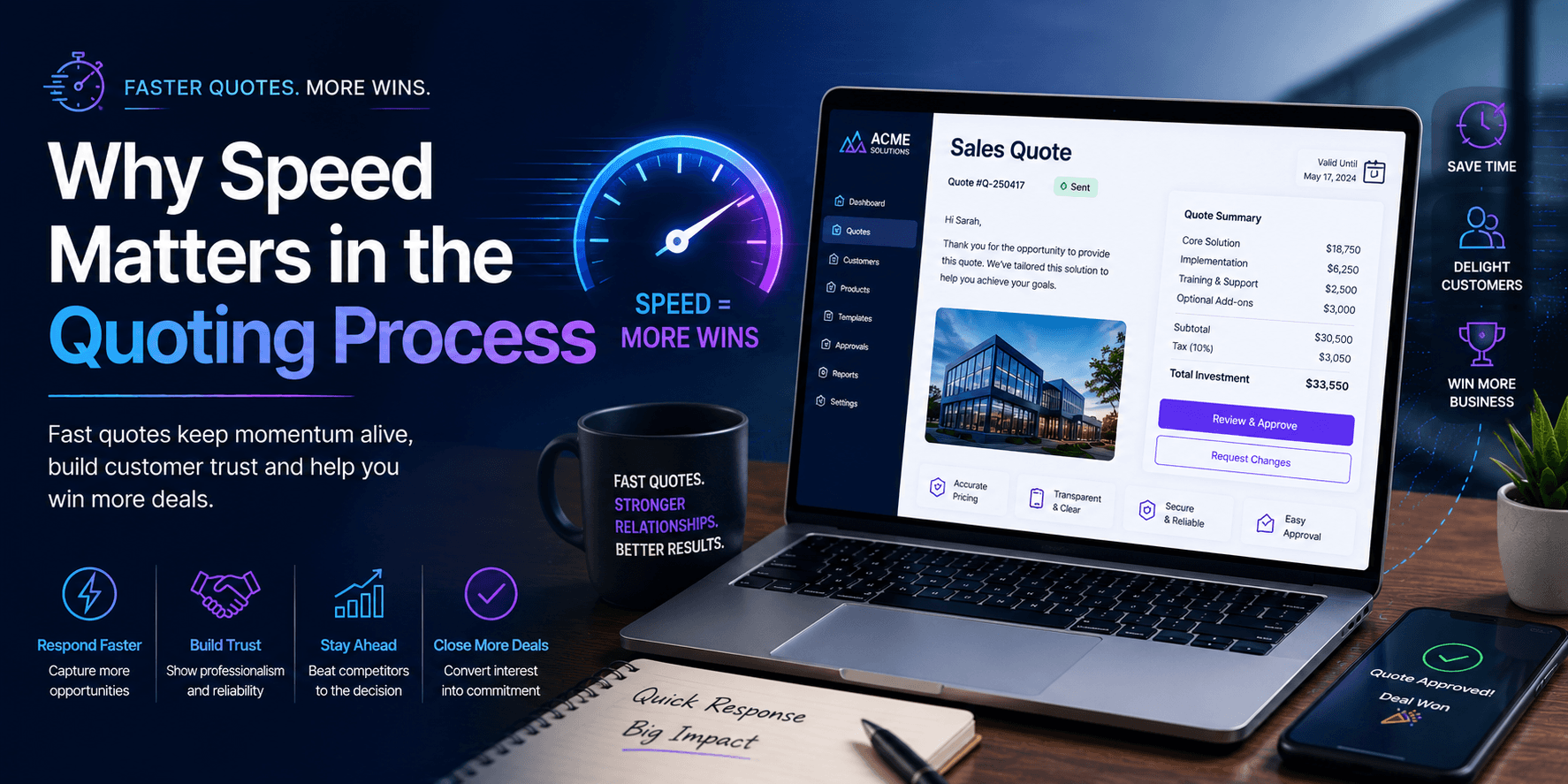
Why Speed Matters in the Quoting Process
Most businesses assume customers buy from the supplier with the best product, the best service or the best price.
While those things certainly matter, they are often not what determines who wins the deal.
In reality, many sales opportunities are won or lost during the period between customer interest and quote delivery. It is a stage that rarely receives much attention, yet it can have a profound impact on conversion rates.
The reason is simple. Customer enthusiasm has a shelf life.
Every sales conversation creates momentum. A prospect becomes interested, starts imagining solutions and begins discussing possibilities internally. For a brief period, the opportunity feels urgent and important. Then the customer asks for pricing and waits.
What happens next often determines whether the opportunity moves forward or slowly fades into the background.
Momentum Is One of the Most Valuable Assets in Sales
Experienced salespeople understand that momentum is difficult to create and surprisingly easy to lose.
When a prospect reaches the point of requesting a quote, they are actively engaged. They are investing time, asking questions and evaluating whether your business is the right fit. It is one of the strongest buying signals a customer can give.
Yet many organisations respond to that buying signal with a process that feels slow, fragmented and administrative.
Sales teams search through spreadsheets, copy information from previous documents, seek internal approvals and manually rebuild pricing tables. What should be a straightforward process becomes a bottleneck.
The customer does not see any of this internal activity. All they experience is silence.
And in sales, silence rarely works in your favour.
Customers Rarely Stop Evaluating Alternatives
One of the biggest misconceptions in B2B sales is the belief that customers pause their buying journey while waiting for your quote.
They do not.
While your team is preparing pricing, the customer is often continuing conversations with competitors, researching alternatives, discussing budgets internally and reassessing priorities.
Every day that passes creates opportunities for distractions, competing projects and alternative solutions to enter the conversation.
This is why businesses that invest in sales quoting software frequently see improvements in conversion rates without changing anything else about their sales process.
They are not necessarily becoming better salespeople. They are simply responding while customer interest is still at its peak.
Speed Creates a Perception of Competence
Customers draw conclusions about businesses from every interaction they have.
When a quote arrives quickly, accurately and professionally presented, customers naturally assume the business behind it is organised and efficient.
It sends a subtle message that the company knows its products, understands its pricing and has confidence in its own processes.
Conversely, when a quote takes a week to arrive, customers often begin questioning what is happening behind the scenes.
If it takes this long to create a quote, how long will implementation take? How responsive will support be? How efficient is the organisation overall?
These thoughts may never be spoken aloud, but they can quietly influence purchasing decisions.
The quoting process often becomes a preview of what it feels like to work with your business.
Modern Buyers Expect Immediate Access to Information
Customer expectations have changed dramatically over the past decade.
People are now accustomed to accessing information instantly. They can compare products, review pricing, sign agreements and complete transactions from almost any device.
Yet many sales organisations still rely on quoting processes that were designed twenty years ago.
The disconnect is becoming increasingly noticeable.
Businesses that embrace modern sales quote software are recognising that quoting is no longer simply an administrative function. It is part of the customer experience.
Customers expect responsiveness because responsiveness has become the standard in almost every other aspect of business.
The Fastest Businesses Are Not Always Cutting Corners
There is sometimes a misconception that speed comes at the expense of quality.
In reality, the opposite is often true.
Businesses that quote quickly are usually not rushing. They have simply invested in better systems.
Product catalogues are organised. Pricing structures are centralised. Templates are standardised. Approval workflows are streamlined. Information is available when it is needed rather than buried inside disconnected spreadsheets and folders.
Modern sales quote apps and digital quoting platforms help businesses remove operational friction that traditionally slows the quoting process down.
The result is not just faster quotes. It is often more accurate quotes as well.
Speed Matters Even More in Competitive Markets
In highly competitive industries, timing can become a significant differentiator.
Consider a commercial furniture supplier responding to a new office fit-out opportunity. Or a recruitment agency competing for a large hiring project. Or a marketing agency pitching for a new account.
In each case, multiple suppliers may be offering similar expertise, similar pricing and similar outcomes.
The business that responds first often gains a psychological advantage.
They appear more responsive. More organised. More invested in the opportunity.
Customers naturally begin engaging with the information that arrives first, and those early conversations can influence how subsequent proposals are evaluated.
Speed alone will not win every deal, but it frequently shapes the competitive landscape before pricing is even compared.
The Future of Quoting Is About Removing Friction
The businesses achieving the strongest results from modern quoting technology are not necessarily obsessed with speed itself.
They are focused on removing friction.
Faster quote creation is simply the outcome of a better customer experience.
Customers want pricing that is easy to understand, approvals that are easy to complete and interactions that feel effortless. Businesses that can provide that experience consistently are often rewarded with stronger conversion rates and shorter sales cycles.
This is why many organisations are moving beyond traditional documents and embracing interactive proposal software, CPQ software and modern document generation software as part of their quoting workflow.
They recognise that quoting is no longer a back-office activity. It is a critical customer touchpoint.
Final Thoughts
Businesses often spend enormous effort trying to improve products, optimise pricing and refine sales techniques, yet overlook one of the simplest competitive advantages available to them.
Responding faster.
A faster quoting process helps preserve momentum, strengthens customer confidence and creates a more professional buying experience. It reduces opportunities for competitors to gain ground and allows prospects to make decisions while enthusiasm is still high.
Ultimately, speed matters because buying decisions are rarely made in a vacuum. Customers are constantly evaluating options, priorities and perceptions.
The businesses that can move quickly, communicate clearly and make purchasing feel effortless are often the businesses that win.