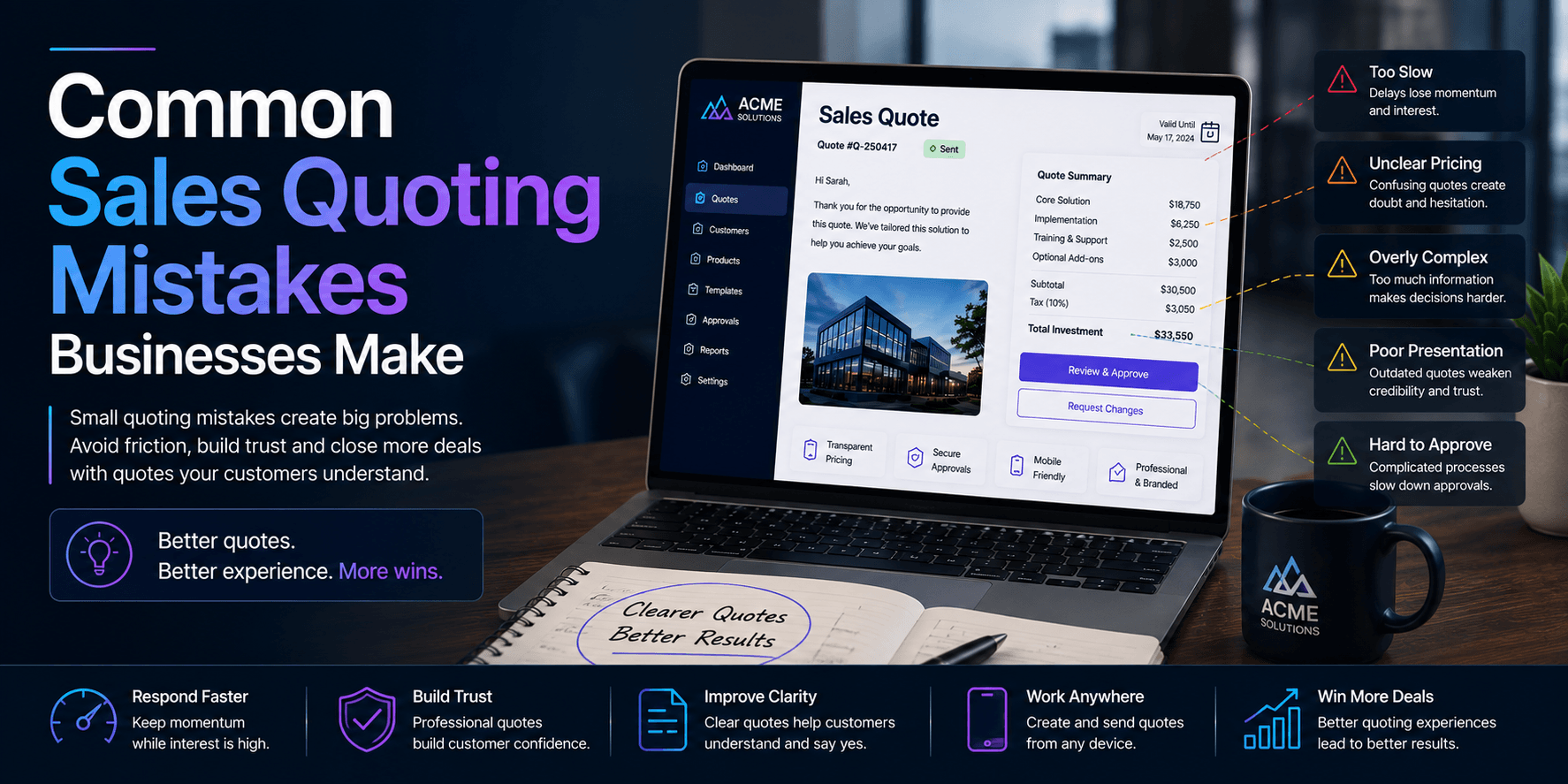
Common Sales Quoting Mistakes Businesses Make
Ask almost any sales manager why a deal was lost and you'll often hear the same answers. The price was too high. The competitor was better known. The customer changed direction or delayed the project.
Sometimes those explanations are true.
But after watching thousands of businesses prepare quotes over the years, one thing becomes increasingly obvious: many opportunities are not lost because of the product or the price. They are lost because of the quoting experience itself.
Most businesses don't deliberately create poor quotes. In fact, many spend enormous amounts of time trying to make them better. The problem is that they often focus on the wrong things. They spend hours perfecting wording, adjusting colours or negotiating discounts while overlooking the customer experience that surrounds the quote.
The irony is that customers rarely remember the formatting of a quote.
They remember how easy—or how difficult—it was to make a buying decision.
Many Businesses Mistake a Quote for a Pricing Document
One of the biggest misconceptions in sales is believing that a quote exists purely to communicate price.
It certainly needs to do that, but pricing is only one small part of what the customer is evaluating.
Every quote also communicates something about the business behind it. It tells customers whether the organisation feels organised, responsive and easy to work with. A confusing document filled with inconsistent pricing, unexplained line items and awkward formatting quietly creates uncertainty before anyone has questioned the actual price.
By contrast, a well-structured quote gives customers confidence. It feels considered. It feels professional. More importantly, it feels easy to understand.
Businesses investing in modern sales quoting software are increasingly recognising that quoting is no longer just an administrative task. It has become an important part of the overall buying experience.
Slow Quotes Create Doubt Before Customers Ever Read Them
Time has a strange effect on sales opportunities.
Immediately after a customer meeting, enthusiasm is usually at its highest. Everyone leaves the conversation with a clear understanding of the problem being solved and the value being discussed. The customer asks for pricing and the opportunity feels very much alive.
Then several days pass.
The salesperson is still collecting pricing, checking spreadsheets, chasing approvals and updating documents. Meanwhile the customer has continued talking to competitors, attended other meetings and shifted attention to completely different priorities.
By the time the quote finally arrives, the buying momentum has already started fading.
This is one of the biggest reasons businesses adopt sales quote software. Faster quote creation is not simply about saving internal administration time. It is about responding while customer interest is still strongest.
Customers Should Never Have to Interpret Your Pricing
Another surprisingly common mistake is assuming customers will work out what everything means.
Businesses become so familiar with their own products that they forget customers are seeing the pricing for the very first time. Internal product names, technical abbreviations and complicated pricing structures make perfect sense to the sales team, but often leave customers wondering exactly what they are paying for.
Whenever customers need to stop reading and start interpreting, confidence begins to slip.
Great quotes remove that effort. They guide customers naturally through the information, making pricing feel logical rather than complicated. The customer spends less time decoding the quote and more time thinking about the value being delivered.
That subtle shift has a remarkable effect on conversion rates because people naturally move faster when decisions feel simple.
Too Many Quotes Still Look Like Spreadsheets
There was a time when customers expected quotes to look like accounting documents.
Those days are disappearing quickly.
Modern buyers compare experiences just as much as they compare pricing. They purchase products online, sign contracts digitally and expect information to be presented clearly across every device they use.
Then many businesses send a PDF that looks like it was exported directly from an accounting package.
It immediately feels disconnected from every other interaction the customer has had with the business.
Modern proposal software is helping businesses bridge that gap by combining pricing with richer presentation, branding and interactive customer experiences. The result is a quote that feels like part of the sales journey rather than the end of it.
Businesses Often Optimise for Internal Processes Instead of Customer Decisions
Perhaps the most interesting quoting mistake is one businesses rarely notice themselves.
Many quoting processes are designed around internal efficiency rather than customer psychology.
The document reflects how the business stores products, organises departments or manages accounting codes. Unfortunately, customers do not think that way.
They think in terms of outcomes.
They want to know what problem is being solved, what they are buying, why it represents good value and what they need to do next.
When a quote is organised around those questions instead of internal systems, buying becomes much easier.
That is why many businesses are moving towards CPQ software, allowing pricing to be generated from complex product catalogues while still presenting the final quote in a way that makes sense to customers rather than databases.
The Approval Process Is Often More Complicated Than the Sale
Even when businesses create excellent quotes, they sometimes undo all that work at the final step.
Customers are asked to print documents, scan signatures, download attachments, email approvals and coordinate paperwork across multiple stakeholders. Every extra click creates another opportunity for delay.
The best quoting experiences feel almost effortless. Customers review the quote, ask any remaining questions and approve it immediately because nothing stands in their way.
Modern sales quote apps and electronic signature workflows have dramatically simplified this part of the buying journey, allowing customers to move from interest to commitment without unnecessary administration.
The Future of Quoting Is About Customer Experience
Businesses sometimes assume better quoting is about producing prettier documents.
In reality, it is about reducing friction.
Every improvement that makes a quote easier to understand, faster to deliver, simpler to approve or more engaging to review contributes to a smoother buying experience.
This is why the most successful organisations increasingly see quoting as part of their competitive strategy rather than simply an administrative necessity. Modern sales quoting apps, document generation software and intelligent proposal platforms are helping businesses remove obstacles that once slowed deals down.
Customers rarely notice when a quote is easy.
They simply move forward.
Final Thoughts
Most quoting mistakes are not dramatic.
They are small moments of friction that quietly accumulate throughout the buying process. A delayed response here. A confusing pricing table there. An awkward approval workflow at the very end.
Individually they seem insignificant.
Collectively they can determine whether a customer chooses your business or someone else's.
Businesses that consistently win more opportunities tend to understand one simple principle.
A sales quote is never just a quote.
It is one of the most important customer experiences your business will ever create.