
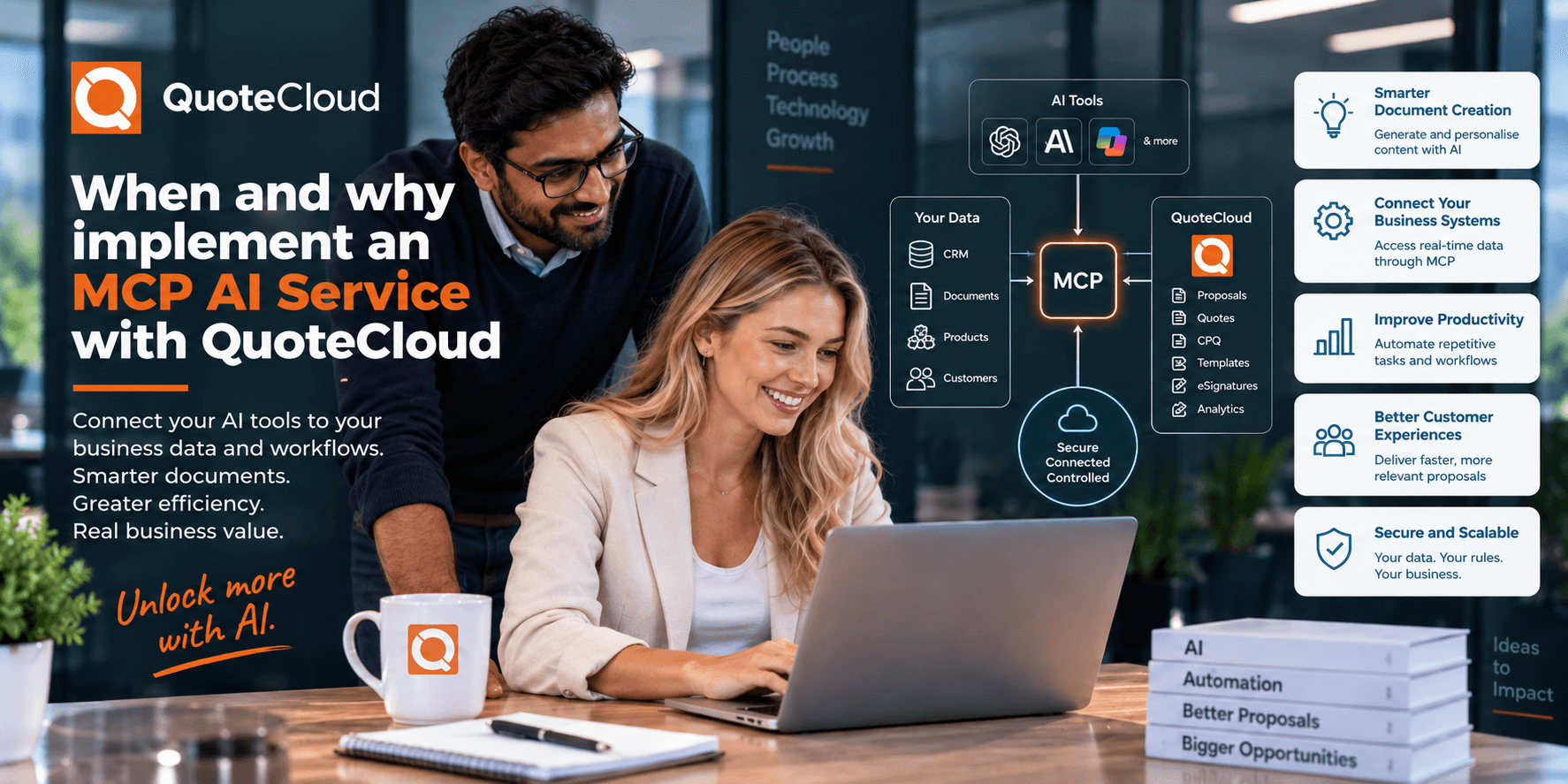
When and Why to Implement an MCP AI Service with QuoteCloud
Artificial intelligence is moving quickly from being something people use in isolation to something that increasingly needs to interact with the systems where real business work happens. Generating an email, summarising a document or answering a question is useful, but the larger opportunity appears when AI can understand customer information, work with pricing data, retrieve approved content, inspect documents and participate in a broader workflow rather than operating as a separate assistant sitting beside the business.
This is where the Model Context Protocol, or MCP, becomes relevant. At a practical level, MCP provides a standard way for AI applications to connect to external tools and data sources. Instead of building a completely different custom integration for every AI system, an organisation can expose selected capabilities through an MCP service and allow compatible AI applications to interact with them in a more consistent way.
That sounds technical, but the commercial question is much simpler. If a sales team wants AI to do more than write generic text—if it needs AI to understand a real customer, retrieve current product information, work with live pricing, create a proposal or trigger a controlled business action—then there needs to be a reliable bridge between the AI and the business systems behind the sale.
That is the point at which an MCP AI service starts becoming strategically interesting for a platform such as QuoteCloud.
MCP Matters When AI Needs Context, Not Just Intelligence
The limitation of a standalone AI tool is not necessarily intelligence. Modern models can already write, analyse, summarise and reason remarkably well. The limitation is context. An AI assistant may know how to write a persuasive sales proposal, but unless it can access the customer's actual requirements, approved product descriptions, pricing rules, historical documents and current commercial data, it is still working with an incomplete picture.
This distinction is important because business documents depend heavily on context. A proposal for one customer should not be generated from the same assumptions as a proposal for another. Pricing may depend on quantities, contract terms, customer type or negotiated agreements. Product availability may change. Approved legal clauses may differ according to region. A salesperson may need information from a CRM, product catalogue, previous proposal or internal knowledge source before they can prepare the document correctly.
Without access to those systems, AI can assist with wording but not necessarily with the complete commercial workflow. It might draft an introduction beautifully while still relying on someone to find the customer information, verify the prices and manually assemble the final proposal.
An MCP service changes the architecture of that interaction. Rather than asking users to repeatedly copy information into an AI conversation, the AI can be given controlled access to the relevant business capabilities. In a QuoteCloud environment, that could mean enabling an AI application to retrieve proposal data, access approved content, locate products or initiate a defined document action, depending on how the MCP service has been designed and authorised.
The Strongest Use Case Is Removing Repetitive Sales Administration
The real value of an MCP AI service is unlikely to come from adding AI for its own sake. It comes from eliminating work that currently sits between a salesperson's intention and the final commercial outcome.
Consider how a typical sales proposal might be created today. A salesperson reviews the opportunity in a CRM, searches previous correspondence, identifies the correct products or services, finds approved content, prepares pricing, checks whether a discount requires approval and then assembles the proposal. Even when a business already uses good proposal software, some of that work may still require the user to navigate between systems and interpret the information manually.
Now imagine an AI assistant with controlled MCP access to the relevant business systems. The salesperson could ask it to prepare a proposal for a particular opportunity, and the AI could potentially retrieve the customer context, identify relevant information, use approved content and interact with QuoteCloud to begin constructing the document. The salesperson remains responsible for judgement and approval, but the mechanical work around gathering and assembling information can be reduced significantly.
This is where AI begins to move from content generation into workflow participation.
The difference is commercially important. A salesperson who spends less time searching, copying and formatting can spend more time understanding the opportunity, speaking with customers and deciding what should actually be proposed. The goal is not necessarily to automate the salesperson out of the process. It is to automate the parts of the process where human judgement adds little value.
MCP Can Make AI More Useful Across Quoting, Proposals and CPQ
The opportunity becomes even more significant in sales environments where pricing and configuration are complex. AI can generate impressive text very quickly, but a commercial document is only useful if the underlying offer is correct. A proposal with the wrong price, an invalid product combination or outdated commercial terms is not improved by eloquent writing.
This is why an MCP AI service can complement sales quoting software and CPQ software particularly well. The AI does not need to invent commercial logic. Instead, it can interact with systems that already contain the approved rules for configuration, pricing and quoting.
That separation is important. The AI can help interpret what the customer appears to need, but the pricing engine should still determine what can validly be sold and at what price. The AI can help assemble the proposal, but the underlying product and pricing data should come from controlled sources. The AI can make recommendations, but the business should retain authority over commercial rules.
This creates a much more reliable model than asking a general-purpose AI tool to produce a quote from memory or from information pasted into a prompt. The intelligence remains flexible, while the business logic remains governed.
For companies with relatively simple pricing, the benefit may be speed. For companies with sophisticated configurations, the benefit may be consistency as much as speed. In both cases, MCP can provide the connection layer that allows AI to work with the systems responsible for the commercial truth.
The Business Case Becomes Stronger When Several Systems Need to Work Together
A single integration can often be solved directly. If a business only wants one AI application to retrieve information from one system, a dedicated API integration may be entirely adequate. MCP becomes more interesting when the environment starts becoming broader.
A sales workflow may involve a CRM, QuoteCloud, product information, internal documents, a pricing source and perhaps a customer support or project-management system. Different AI applications may also be used by different teams. Building unique point-to-point integrations between every combination quickly creates complexity.
A standardised MCP layer can reduce some of that integration fragmentation by giving AI tools a consistent way to discover and interact with approved capabilities. This does not eliminate the need for engineering, governance or APIs underneath the system, but it can simplify the way AI applications access them.
That is particularly valuable as organisations experiment with different AI platforms. The AI model or interface selected today may not be the one the business prefers in two years. A well-designed MCP service can help separate the business capabilities from the particular AI application using them.
This is one of the more important architectural reasons to consider MCP. The value is not merely connecting AI to QuoteCloud once. It is creating a controlled interface through which authorised AI systems can interact with QuoteCloud and potentially the wider business environment without rebuilding the same integration logic repeatedly.
Security and Governance Should Decide What the AI Is Allowed to Do
The more useful an AI integration becomes, the more important governance becomes. Giving an AI system access to real customer information and business actions is fundamentally different from using AI to rewrite a paragraph of marketing copy.
An MCP implementation therefore needs to begin with boundaries. Which information can the AI retrieve? Which customers can a particular user access? Can the AI create a proposal but not send it? Can it suggest pricing but not approve a discount? Can it read an agreement but not alter contractual wording? Which actions require human confirmation?
These questions are not obstacles to implementation. They are part of the design.
The current MCP specification has continued evolving around production deployment, scalability and authorisation, reflecting the fact that enterprise use requires more than simple connectivity.
For a QuoteCloud implementation, the safest approach is generally to expose only the tools and data the AI genuinely needs for a defined workflow. A proposal-drafting assistant may require access to customer information and approved content but may not need authority to send the proposal. A sales assistant helping users find documents may require read access but no write capability at all.
This principle—minimum necessary access—helps keep AI useful without making it unnecessarily powerful.
It also keeps accountability clear. AI can prepare, recommend and automate, but organisations should still decide where human review remains appropriate, particularly around pricing, legal terms, contractual commitments and other commercially significant actions.
Not Every Business Needs an MCP Service Yet
The enthusiasm around AI can make every new technical capability look urgent. MCP is no exception. But there are situations where implementing it would add complexity without creating enough practical value.
If a business uses AI only for general writing assistance, there may be little reason to build an MCP service. If sales volume is low and proposals are highly bespoke, manual interaction may still be appropriate. If the underlying customer and pricing data is poorly structured, connecting AI to it will not solve the fundamental problem. Automation works best when the systems behind it already contain reliable information and reasonably well-defined workflows.
The implementation case becomes stronger when the business can identify repetitive activities that AI could perform if it had secure access to QuoteCloud or related systems. Perhaps users constantly search for the same content. Perhaps large volumes of similar proposals are produced. Perhaps information is manually transferred from another platform into QuoteCloud. Perhaps salespeople regularly ask the same questions about products, pricing or previous documents.
These are tangible opportunities.
The decision should therefore begin with a workflow rather than an AI strategy document. What are people doing today? Which parts are repetitive? Which decisions require judgement? Which information already exists in systems? What would become faster or better if an AI assistant could securely retrieve that information and take a limited set of actions?
If those questions reveal a meaningful operational benefit, MCP starts to make sense.
The Real Opportunity Is AI That Participates in the Sales Process
The first generation of business AI has largely been conversational. Users ask questions, generate content and receive suggestions. That is already valuable, but it leaves the user responsible for carrying the result back into the business process.
The next stage is more connected.
An AI assistant should be able to understand the customer's situation, access the information required to respond, interact with the systems responsible for the workflow and return the user to a meaningful point in the process rather than simply producing text.
For QuoteCloud, that could ultimately mean AI helping users move from customer context to sales proposal, from product requirements to quote, from existing data to personalised document generation, and from complex information to a commercial document that is much closer to being ready for review.
The value does not come from making every part of that process autonomous. It comes from reducing the distance between what the salesperson wants to achieve and the work required to achieve it.
QuoteCloud already sits at an important point in the sales process where customer information, pricing, proposal content, interactive documents and acceptance come together. An MCP AI service can extend that environment by giving compatible AI applications a structured way to interact with approved QuoteCloud capabilities and the business data surrounding them.
The reason to implement MCP is therefore not simply that AI can connect to QuoteCloud. It is that connecting AI to real business context can turn it from a writing assistant into a useful participant in the commercial workflow.
For some organisations, that opportunity will justify implementation immediately. For others, the right decision will be to wait until the underlying data, processes and use cases are mature enough.
Either way, the starting question should remain practical: if the AI had safe access to the right information and actions, what useful work could it actually remove?
When the answer is clear, the case for MCP usually becomes clear as well.